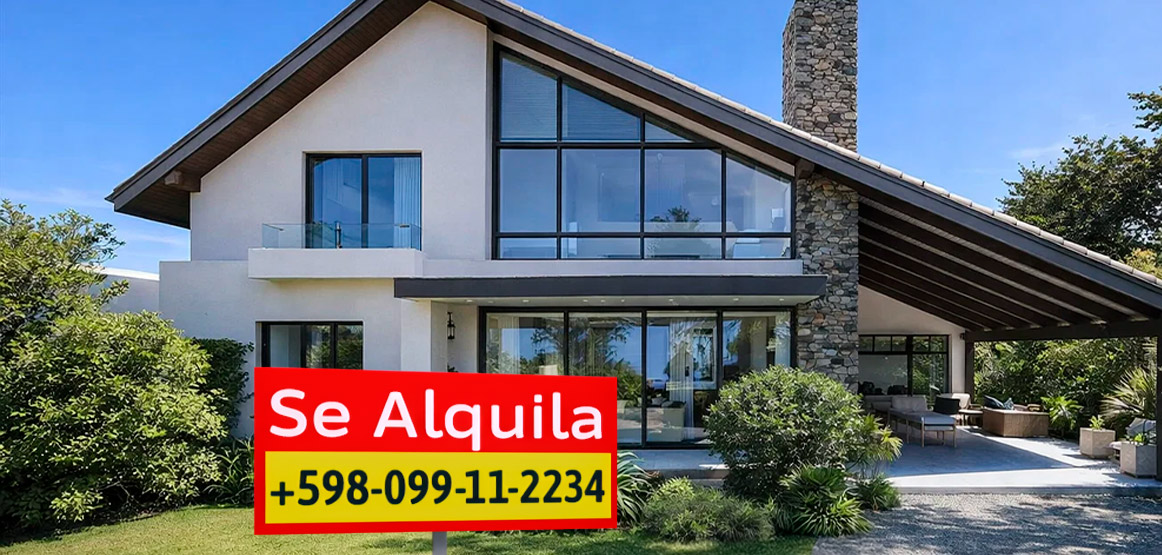
The rental market in Punta del Este is evolving beyond summer. Seasonal, winter and annual rentals coexist in a market where demand is shifting and pricing is becoming more strategic.
In Punta del Este, talking about rentals means talking about timing. Not only summer, which still sets the pace, but also how that traditional calendar is beginning to shift. Three well-defined models now coexist (seasonal, winter and annual), but what has changed is the logic behind each one: prices no longer respond only to seasonality but to a more competitive, better-informed market, with demand that is starting to diversify.
Seasonal rentals: the peak of market value
Seasonal rentals remain the historic core of the business. They are concentrated between December and February, with sharp peaks at year-end and in the first half of January, when the highest prices are reached.
In that period, a well-located two-bedroom apartment can start at USD 2,500 to USD 3,500 per fortnight and climb easily to USD 6,000 or USD 8,000 in premium or front-line buildings. For houses, especially in areas such as La Barra or José Ignacio, prices can range from USD 5,000 to USD 20,000, USD 40,000 or even more per fortnight, depending on location, design and services.
For years, this format allowed very high margins, sustained by strong international demand concentrated in a few weeks. That scenario has begun to adjust. A larger supply, a more professional market and the ability to compare prices in real time have made pricing more strategic. Today, setting the right price is as important as the property itself.
Winter rentals: continuity and balance
Off-season comes the winter rental, a quieter model but a key one for many owners. It generally runs from March or April to November, on the condition that the property is available for the following summer.
Prices fall considerably. An apartment that rents for USD 6,000 per fortnight in January may be offered in winter for between USD 800 and USD 1,500 per month. For houses, prices usually range between USD 1,000 and USD 3,000 per month, depending on the area and the level of equipment.
More than a source of high returns, the winter rental works as a tool to keep the property active, cover expenses and avoid long vacancy periods. It is an intermediate format that bridges the transition between seasons.
Annual rentals: the new demand redefining the market
If one segment has been gaining ground, it is the annual rental. In recent years, demand has grown steadily, driven largely by foreigners who come to Uruguay intending to settle.
Many of them do not look to decide quickly: they prefer to rent, get to know different areas, understand the pace of life and only then move on to a purchase. This change in behavior is redefining the market.
Annual rentals offer stability to both owner and tenant, with contracts that usually run 12 to 24 months. Prices here are more moderate but steady. A two-bedroom apartment can rent for between USD 1,200 and USD 2,500 per month, while a house can range from USD 2,000 to USD 5,000 or more in established neighborhoods or those with good infrastructure.
What is interesting is that this format is starting to compete, in some cases, with seasonal rentals. Not on direct return, but on predictability. Less turnover, less management and steady income over time are factors that more and more owners value.
How a rental price is set today
The rental market in Punta del Este is no longer predictable in traditional terms. Today, the final price is not defined only by location or sea views.
The quality of the product, the level of equipment, direct competition in the area and, above all, the ability to adapt to a more demanding market all play a part. The margin is no longer guaranteed: it is built from a well-thought-out strategy.
A market that is starting to think year-round
Punta del Este is still a summer destination. But more and more, it is also becoming a place to stay.
The growth of annual rentals and higher occupancy outside the season reflect a deeper transformation: the resort is evolving into a city that can be lived in all year round, with a real estate market that broadens its logic and becomes more stable.
In this new scenario, understanding how the different types of rentals work is no longer just an advantage: it is a key tool for making better decisions, both for owners and for those looking to settle in one of the region’s most dynamic destinations.
Relocation & Advisory #PDE
https://modopunta.com/en/relocation-advisory-punta-del-este/
Relocation and advisory Punta del Este
Keep browsing #ModoPunta
Content and experiences produced to understand how Punta del Este is lived
center top no-repeat
grid
date
DESC
real-estate
información, venta-casas