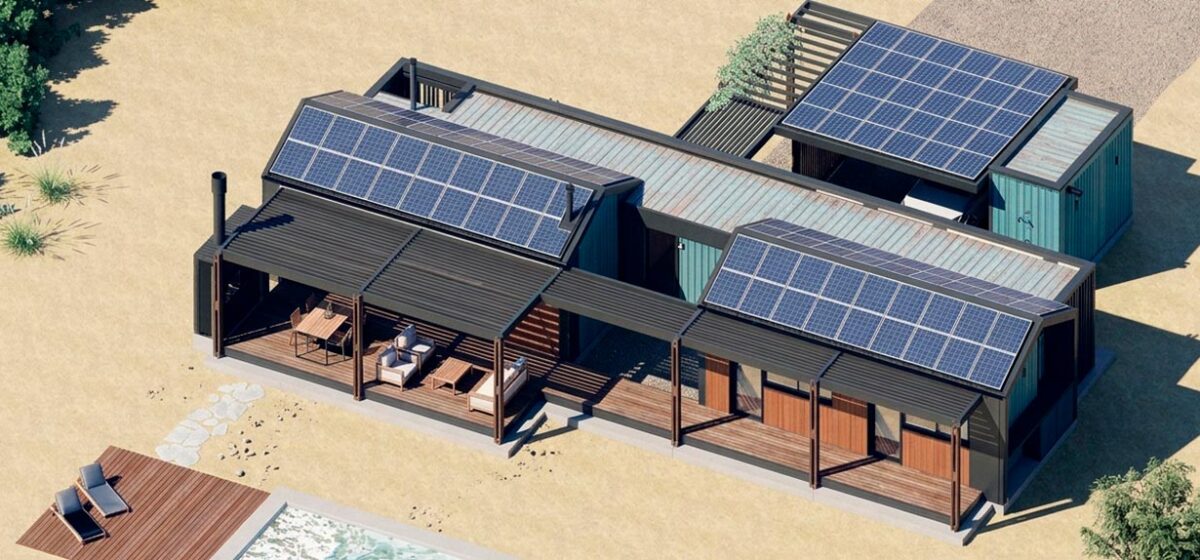
For a house connected to the grid, the UTE service cannot be replaced: the microgeneration rules start from the premise that the generator is a UTE subscriber. Panels reduce the bill and, depending on the scheme, allow surplus energy to be sold, but the contract and the contracted power remain. A house with no grid connection is a different case, and registering it is legally possible.
Why the UTE contract does not go away
Decree 173/010 authorizes subscribers connected to the low-voltage grid to install renewable generation. Its relevant points:
- The microgenerator is a “UTE subscriber” (articles 2 and 4): without a contracted supply there is no microgeneration.
- The installed peak power must be less than or equal to the contracted power (article 1), with a current cap of 16 A (25 A for single-phase with ground return).
- Before connecting, a connection agreement must be signed with UTE (article 3).
- The system can exchange energy with the grid in both directions. UTE buys the energy delivered for 10 years, at the price of the energy charge of the subscriber’s tariff (article 4).
A likely technical explanation is that, without a battery, the house depends on the grid at night; the decree, however, does not say so.
What the self-consumption registry says
The Registration or Authorization of Generation at a Subscriber procedure of the Ministry of Industry, Energy and Mining covers all self-consumption plants, whether grid-connected or off-grid.
| Case | What is required | Link to UTE |
|---|---|---|
| Up to 150 kW | Registration: holder, contact, power, primary source and location | If connected, UTE account number |
| Over 150 kW | Authorization by express administrative act | Holder identified as a subscriber, with account number |
| Off-grid installation | Property registration number, location, AC power, battery, installer, estimated start date | None: there is no UTE account |
The procedure is free, done online only with a gub.uy user, and processed by the National Energy Directorate. An installation is considered self-consumption if, even when connected, it keeps a zero annual balance and delivers no surplus.
The hypothesis of a house without UTE
There is no rule, in what we reviewed, that forces an off-grid dwelling to connect to the grid, and the registry explicitly provides for the off-grid case. But that does not mean a house can be lived in in Maldonado without a supply: the requirements for approval by the Municipality (completion of works, electrical installation) and the URSEA standards remain to be checked.
What each avoided kWh is worth
Each kWh the system avoids buying from UTE is valued at the price of its tier in the Simple Residential Tariff: between UYU 6.744 and UYU 10.539 per kWh (Uruguayan pesos, before taxes), depending on monthly consumption, according to Decree 339/025, in force since January 1, 2026. The contracted power (UYU 83.2 per kW) and the monthly fixed charge (UYU 324.9) are still paid even with panels.
What it means for buyers
- When evaluating a property with panels, ask for the connection agreement with UTE and the account number: the system is tied to the supply.
- When changing the holder of the supply, check that the connection agreement and the microgeneration conditions are transferred with the account.
- A system sized on the contracted power limits how much can be installed without changing the tariff.
Keep reading
- How to change the holder of a UTE electricity service
- How to transfer the OSE water account
- How to buy property in Uruguay as a foreigner (in Spanish)
And next?
Looking for an efficient house on the coast? See the properties for sale in the area and the modular homes by Modo Houses.
View properties for sale (in Spanish)